
05122542104, 9839088890
admin@kanpururologist.com
Kidney Stones are also known as Nephrolithiasis or Renal Calculi. These hard deposits form inside one or both the kidneys and vary in size and number.
Kidney Stones form when an imbalance occurs in the various chemicals that are present in the urine. The most commonly involved chemicals are calcium, oxalate, citric acid, uric acid and cysteine.
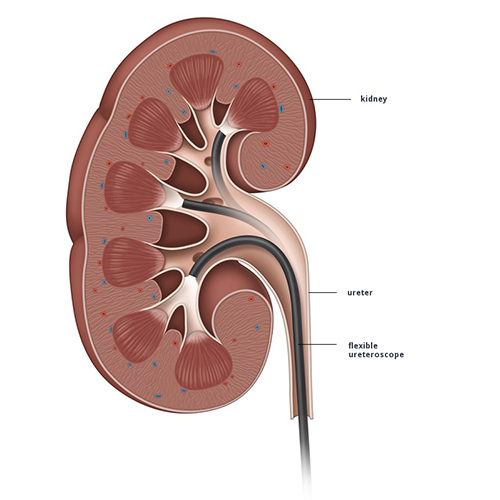
Retrograde Intrarenal Surgery (RIRS): This is a medical procedure used in urology for the treatment of kidney stones. It involves passing a small fiberoptic instrument called a ureteroscope through the urethra and bladder, up into the ureter, and then into the kidney. This allows the surgeon to visualize and access the kidney stones to break them up or remove them.
Minimally invasive
A straightforward and faster method
Shorter recovery time
Less painful
Less morbidity
Insignificant bleeding
No danger to the renal tissue
Less inconveniences
A retrograde intrarenal operation (RIRS) is a simple, less invasive, and less likely to cause problems. Before Surgery, patient need to undergo these tests.
In a few situations, pre-operative DJ stenting is required two weeks before the procedure; this stenting allows the ureteroscope to enter the kidneys more easily because the ureter is already dilated. Patients are kept 6–8 hours on an empty stomach before surgery.
The patient will be sedated with anaesthesia, and the urologist will use a digital or fibre optic endoscope – a thin, flexible tube – to reach the bladder through the urethra and then to the kidney’s urine storage area. The endoscope will detect stones and blast them with a laser until golden sand forms.
Furthermore, the DJ stent is to be placed for 1 to 2 weeks before or after the RIRS surgery, aids the smoothing and speeding of recuperation; in most cases, patients are discharged the next day following surgery.
A urologist inserts a urinary catheter into the urethra to relieve pain and difficulty peeing; the catheter is left in place for 8 to 24 hours. After that, the patient will be shifted to the recovery room for monitoring for 6 to 8 hrs after the surgery. The patient will be taken to a hospital room to rest for at least 24 hours.
Furthermore, the patient must drink a large amount of fluids each day, at least 3 litres, in order to avoid infection and maintain urine output. In addition, if the patient is in good health and is able to resume normal activities the next day after surgery, he or she may be discharged. However, a follow-up with the primary care doctor is important.